
Omotesando has great shopping, architecture, restaurants and coffee shops. It’s central, easy to walk around, and much calmer at night than Shibuya or Shinjuku.
There’s just one problem if you want to stay here: there are surprisingly few hotels. Search for hotels near Omotesando and you’ll find very little.
And it’s not because you haven’t searched hard enough. There really aren’t many.
I live nearby, and it’s something I’ve always found a little strange. For an area so closely associated with fashion, architecture and design, Aoyama and Omotesando have very few interesting places to stay — especially if you’re looking for an upscale boutique hotel rather than a large international hotel or a basic business hotel.
That may finally be changing. Two new developments are bringing hotels to the area, one scheduled for around 2030 and another for 2032.
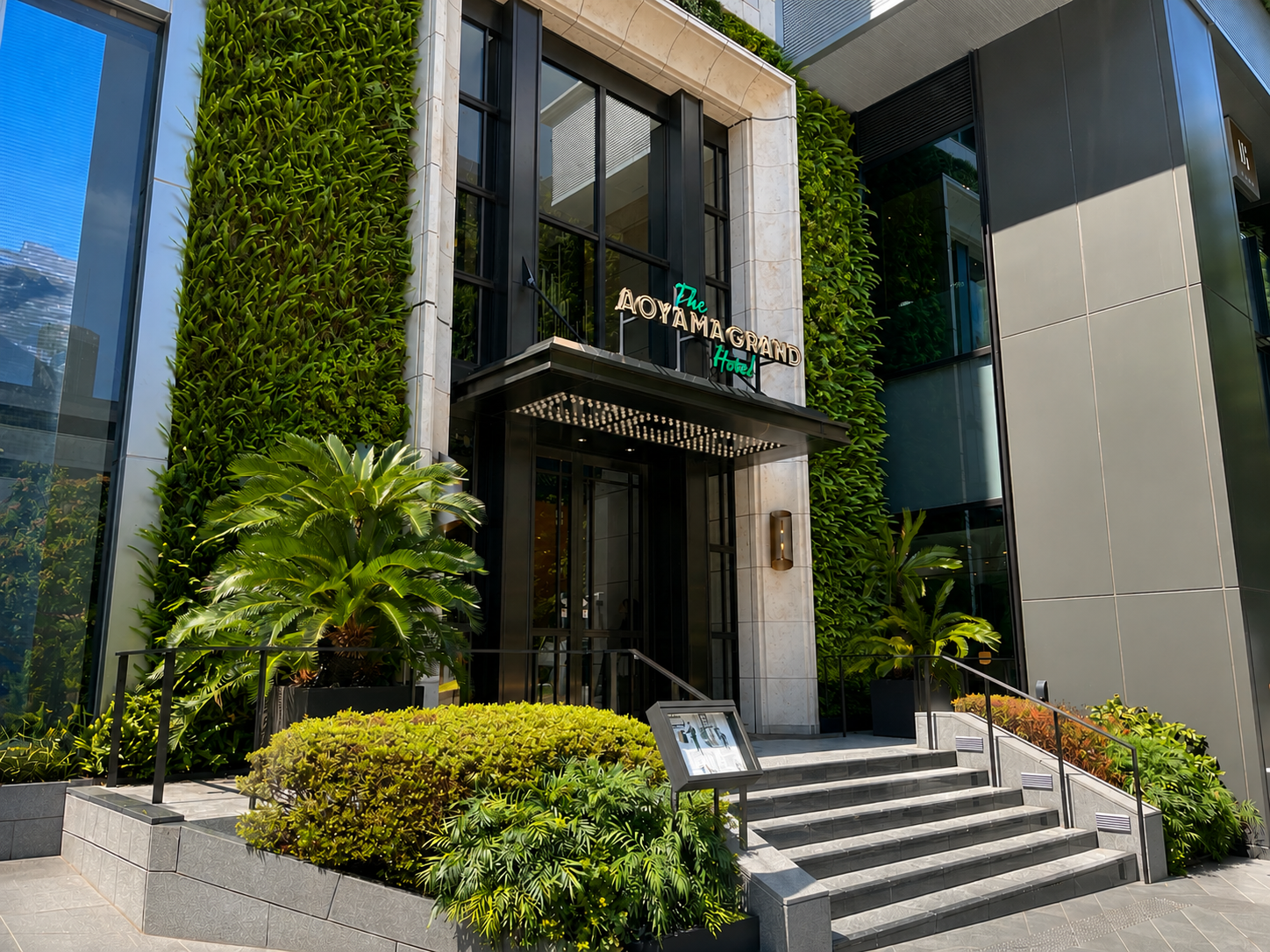
For now, the most obvious upscale option is The Aoyama Grand Hotel — more on that below.
Why Omotesando Is a Great Place to Stay in Tokyo
Omotesando is usually thought of as somewhere to shop rather than somewhere to stay.
But it actually makes a lot of sense as a base in Tokyo.
Walk toward Harajuku and you have plenty of shops and people. Turn into the back streets of Minami-Aoyama, and it gets quiet surprisingly quickly.
Around the Nezu Museum and the residential streets behind Omotesando, there are small restaurants, coffee shops, galleries and boutiques. Some of these streets are remarkably quiet considering how central you are.
You can walk to Harajuku, Cat Street and Shibuya, and Omotesando Station has the Ginza, Chiyoda and Hanzomon subway lines, so getting around the rest of Tokyo is easy.
It’s a particularly good location if you want somewhere quiet and walkable, but not isolated.
So why are there so few hotels?
Omotesando Was Never Really a Hotel District
Tokyo’s major hotels have traditionally been concentrated elsewhere.
Shinjuku has large international hotels. Ginza and Marunouchi have luxury hotels around Tokyo Station. And more recently, Shibuya has added a lot of new hotels as the area has been redeveloped.
Aoyama and Omotesando developed differently.
The area became known for fashion, architecture, offices, restaurants and high-end shopping, with residential streets just behind the main roads. Large plots are hard to come by, land is extremely expensive, and the neighborhood has never really developed as a hotel district.
So you end up with one of Tokyo’s best-known neighborhoods — and surprisingly few places to stay.
It’s not just Omotesando, either. Daikanyama has the cafes, restaurants, shops and quiet residential streets that make it a great neighborhood to spend time in, but there are basically no hotels there.
Tokyo has plenty of excellent hotels. They just aren’t always in the neighborhoods where you might actually want to spend your days walking around.
Tokyo Has Plenty of Luxury Hotels — But Not Many Boutique Hotels
There’s another reason the lack of hotels in Aoyama and Omotesando feels so noticeable: Tokyo doesn’t actually have that many boutique hotels.
There’s certainly no shortage of luxury hotels. Shinjuku, Marunouchi, Ginza, Otemachi and Roppongi all have excellent international hotels, with more continuing to open.
But if you want something smaller, independent and design-led — somewhere that feels connected to the neighborhood around it — the list gets much shorter.
And that feels particularly strange in Aoyama and Omotesando.
This is one of the parts of Tokyo most associated with fashion, architecture and design. There are buildings by some of Japan’s best-known architects, international fashion flagships, independent boutiques, galleries, furniture and interior shops, as well as great restaurants and coffee shops.
It seems like exactly the kind of neighborhood that should have interesting boutique hotels.
But it really doesn’t.
There are exceptions elsewhere in Tokyo — TRUNK is probably the most obvious — but there still aren’t as many small, design-focused hotels as you might expect in a city this size.
Which is why something about one of the new developments in Kita-Aoyama immediately caught my attention: the hotel is specifically being planned as a “small luxury hotel.”
That sounds like exactly what Aoyama has been missing.
Where to Stay Near Omotesando Now
The Aoyama Grand Hotel
If you want to stay in Aoyama or Omotesando and are looking for an upscale hotel, The Aoyama Grand Hotel is the most obvious choice right now.
It’s in Kita-Aoyama, about a three-minute walk from Gaienmae Station and around eight minutes on foot from Omotesando Station.
The location is great. You can walk straight down Aoyama-dori to Omotesando, while the quieter streets of Minami-Aoyama are also just nearby.
If you’re staying nearby, Aoyama Beniya, a traditional matcha stop near Gaienmae, is an easy walk from the hotel.
What About TRUNK(HOTEL)?
There are two TRUNK hotels relatively nearby, although neither is really an Omotesando hotel. They can look close on a map, but they’re a walk away rather than around the corner.
TRUNK(HOTEL) CAT STREET is in Jingumae, between Harajuku and Shibuya. You can easily walk to Omotesando, but the location feels more Harajuku/Shibuya than Aoyama.
TRUNK(HOTEL) YOYOGI PARK is in Tomigaya, on the other side of Yoyogi Park.
Tomigaya is a great neighborhood in its own right, with good coffee shops and restaurants, and TRUNK Yoyogi Park is one of the relatively few genuinely stylish small boutique hotels in Tokyo.
But Aoyama Is About to Change
For years, having almost no hotels has just been part of Aoyama and Omotesando.
Now two fairly major developments are underway.
And one of them is specifically being planned as a small luxury hotel.
2030: A New Small Luxury Hotel in Kita-Aoyama
The first is on Aoyama-dori in Kita-Aoyama 3-chome.
Construction began in June 2026 on the Kita-Aoyama 3-Chome District redevelopment, on land that includes the former Toei Aoyama Kitamachi apartment complex.
This is a much bigger project than just a hotel. Plans include offices, shops and restaurants, cultural and event spaces, a gallery, a members’ library lounge and a large green area.
But the hotel is the part I’m particularly interested in.
Floors 3 through 6 of the B-1 building are planned as a small luxury hotel.
Current plans show guest rooms with balconies overlooking the greenery, as well as a restaurant and fitness facilities.
The wider development is also designed to connect Aoyama-dori with the green space behind it, with shops and restaurants opening onto terraces facing the trees.
Completion is currently scheduled for 2030.
The hotel brand hasn’t been announced yet.
A small luxury hotel overlooking greenery, right in Kita-Aoyama, sounds very different from most of Tokyo’s big luxury hotels — and very right for this neighborhood.
2032: A Hotel Directly Connected to Omotesando Station
The second project is even more central.
Tokyo Metro and Sankei Building are developing a new mixed-use building right by Omotesando intersection on Aoyama-dori.
If you know the area, it’s around the site of the former Mizuho Bank building — basically right in the middle of Omotesando.
The new building is planned to have shops from basement level 2 through the second floor, with a hotel occupying floors 3 through 14.
It will also be directly connected to Omotesando Station, with access to the Ginza, Chiyoda and Hanzomon lines.
Completion is currently planned for fiscal 2032.
The hotel operator and brand haven’t been announced yet.
Once it opens, Omotesando will finally have something it has strangely never really had: a substantial upscale hotel directly connected to the station, right in the middle of the neighborhood.
Omotesando Might Finally Become Somewhere You Can Stay
That’s what I find interesting about these two projects.
For years, people have come to Omotesando to shop, eat, see the architecture or visit places like the Nezu Museum — and then gone back to hotels in Shinjuku, Shibuya, Ginza or somewhere else.
The Kita-Aoyama project sounds much closer to the kind of hotel this neighborhood has been missing: smaller, design-conscious and connected to the surrounding streets and greenery.
And the hotel at Omotesando Station will make staying here incredibly convenient.
Until now, staying in Omotesando has mostly meant choosing from a very short list of hotels — or staying somewhere else and coming here for the day.
By the early 2030s, that may finally change.
Omotesando might finally have hotels that feel like they belong here.